Monorail Locomotive Runaway & Rollback: 7 Causes and Dual Brake Solution
Monorail locomotive brake failure is the leading cause of runaway and rollback incidents in underground coal mine haulage operations. In September 2023, a rollback-triggered runaway at a coal mine resulted in worker casualties — a direct consequence of monorail locomotive brake failure that reduced overall braking force below the safe threshold. This article explains the 7 root causes and how Relystone’s dual independent brake system eliminates them.
7 Causes of Monorail Locomotive Brake Failure Leading to Runaway or Rollback
The majority of suspended monorail transport locomotives currently in operation share a single braking unit across all three braking modes — service braking, safety braking, and emergency braking. This single-brake architecture has a critical vulnerability: monorail locomotive brake failure in any one drive unit causes the entire system’s braking capacity to drop below the threshold required to hold the train on a gradient.
The result is either runaway (uncontrolled downhill acceleration) or rollback (uncontrolled uphill reversal), both of which can cause catastrophic collisions with personnel, equipment, or roadway infrastructure. The 7 most common causes of monorail locomotive brake failure are:
- Brake pad wear — pads worn beyond the minimum thickness limit reduce clamping force below design specification
- Brake pad detachment — physical separation of the pad from the backing plate eliminates braking force from that unit entirely
- Hydraulic seal failure — internal or external leaks reduce cylinder pressure, weakening spring-actuated brake engagement
- Braking surface contamination — oil, water, or coal dust on rail web surfaces reduces friction coefficient between pad and rail
- Single-point failure propagation — in a shared-brake architecture, one failed unit reduces total braking force with no compensating response from remaining units
- Inadequate maintenance intervals — infrequent inspection allows brake components to degrade beyond safe operating limits undetected
- Incorrect brake pressure adjustment — hydraulic pressure set outside the specified 14–16 MPa range reduces braking force or causes premature pad wear
According to ILO underground mine transport safety standards, braking systems for inclined haulage equipment must provide redundant protection against gradient-related runaway — a requirement that single-brake monorail systems cannot reliably meet when monorail locomotive brake failure occurs.
The Solution: Dual Independent Brake System
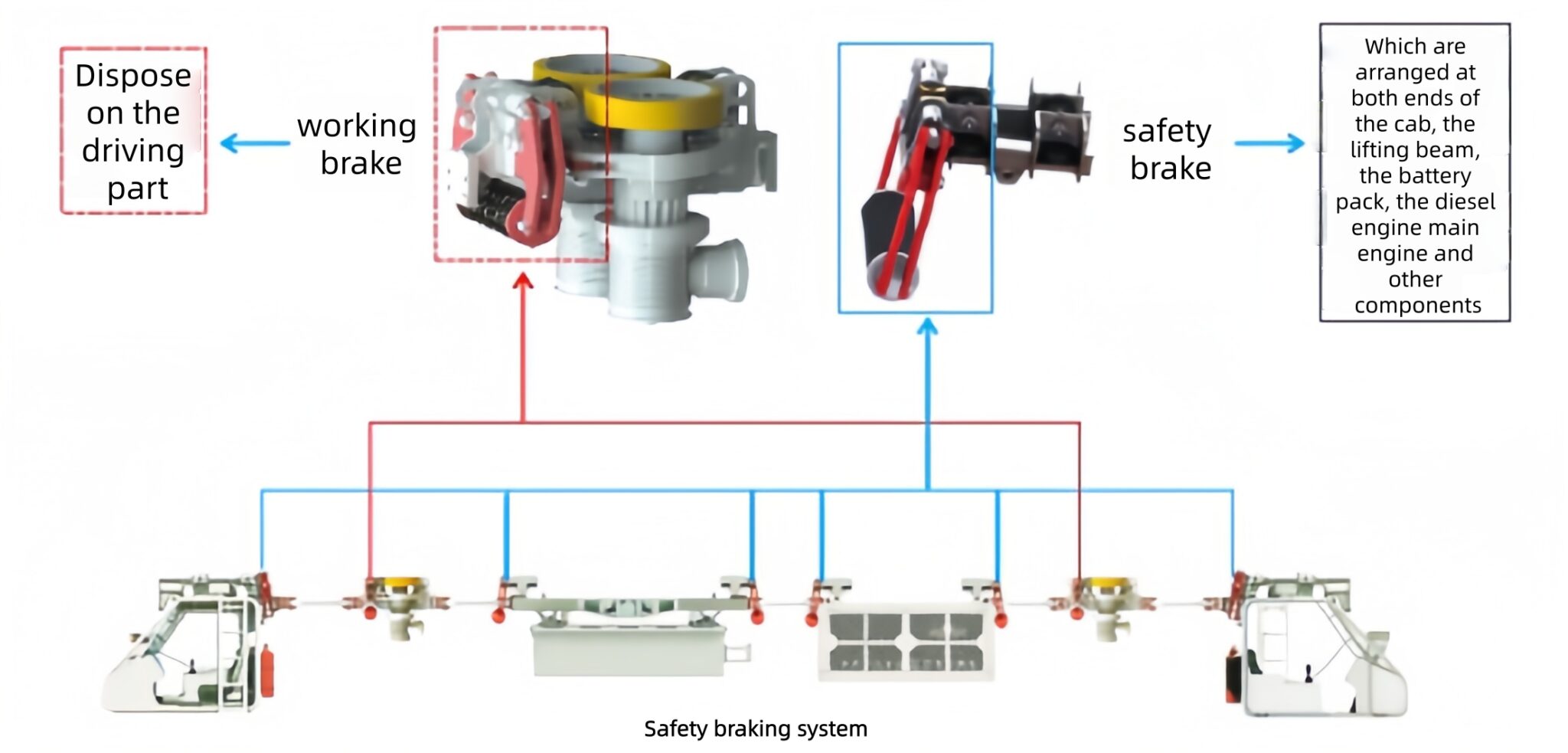
Relystone has developed the industry’s first dual independent brake configuration for suspended monorail transport locomotives. By separating the service brake and safety brake into two fully independent systems — each with its own brake assembly, hydraulic circuit, and electro-hydraulic control system — monorail locomotive brake failure in one system no longer compromises the other.
The two systems operate in parallel. When monorail locomotive brake failure is detected in the service brake, the safety brake activates automatically — without any operator input — maintaining full braking capacity on the gradient.
Level 1: Service Brake (Working Brake)
The service brake is the primary braking system for normal underground monorail transport operations. It engages under the following conditions:
- Normal work stops — shift changes, maintenance, depot return, and scheduled halts
- Emergency stops initiated by the operator
- Safety protection system activation
Level 2: Safety Brake (Emergency Brake)
The safety brake is an independent secondary system that activates when monorail locomotive brake failure occurs in the service brake or when dangerous conditions are detected. It triggers in two ways:
Manual activation — the operator can trigger the safety brake via two independent inputs inside the cab:
- Manual pressure relief of the braking hydraulic valve, releasing spring force to engage the brake
- Emergency brake electrical signal button (panic button) inside the cab
Automatic activation — the safety brake engages automatically without operator input under any of the following 7 conditions:
- Downhill runaway detected — locomotive speed exceeds safe threshold on a descent
- Uphill rollback detected — locomotive reverses direction unexpectedly on an incline
- Engine or battery self-protection activation — diesel engine or lithium battery pack enters protective shutdown
- Traction force less than load force — locomotive cannot maintain controlled movement against gradient load
- Fire detection — onboard fire detection system triggers emergency stop
- Inclined roadway parking — any stationary operation on a gradient automatically engages the safety brake to prevent rollback
- Service brake failure — monorail locomotive brake failure via pad detachment, excessive wear, or hydraulic fault automatically transfers braking to the independent safety brake
How the Dual Brake System Works
Both systems operate on a fail-safe spring-applied, hydraulically released principle. Under normal operating conditions, hydraulic pressure compresses the brake springs and holds the brake pads clear of the rail web. When braking is required — or when monorail locomotive brake failure triggers automatic activation — hydraulic pressure is released and the compressed springs drive the brake pads against the rail web.
Key technical characteristics of the dual system:
- Independent hydraulic circuits — service and safety brake each have separate electro-hydraulic control systems with no shared components
- Dual return oil paths — each system uses two or more independent return oil paths, eliminating single-point hydraulic failure modes
- Spring-applied braking — brake engagement is driven by mechanical spring force, ensuring brakes engage on power or hydraulic loss
- Automatic safety brake takeover — the safety brake activates automatically when monorail locomotive brake failure is detected, without requiring operator input
Single Brake vs. Dual Independent Brake: Key Differences
| Feature | Single Brake System (Industry Standard) | Dual Independent Brake (Relystone) |
|---|---|---|
| Brake assemblies per locomotive | 1 shared unit | 2 independent units |
| Impact of monorail locomotive brake failure | Total braking capacity reduced | Safety brake takes over automatically |
| Runaway/rollback protection | Single point of failure | Redundant, automatic protection |
| Inclined parking safety | Relies on service brake only | Dedicated safety brake engages automatically |
| Hydraulic circuit independence | Shared circuit | Fully independent circuits |
| Operator intervention required | Yes | No — automatic activation |
Frequently Asked Questions
What is the most common cause of monorail locomotive brake failure?
The most common causes of monorail locomotive brake failure are brake pad wear beyond the minimum thickness limit, brake pad detachment, and hydraulic seal leaks that reduce cylinder operating pressure. In single-brake systems, any of these faults directly reduces the locomotive’s total braking capacity — creating runaway or rollback risk on gradients.
How does the dual independent brake system prevent runaway and rollback?
By separating the service brake and safety brake into two fully independent systems, monorail locomotive brake failure in one system no longer compromises overall braking capacity. The safety brake activates automatically when runaway, rollback, or service brake failure is detected — providing redundant protection that single-brake systems cannot offer.
Does the safety brake activate automatically on brake failure?
Yes. When monorail locomotive brake failure is detected — whether due to pad detachment, hydraulic fault, or excessive wear — the safety brake activates automatically without any operator input. It can also be triggered manually via two independent inputs inside the cab for situations requiring immediate operator-initiated emergency stops.
Is the dual brake system available for all Relystone locomotive models?
The dual independent brake system is standard across Relystone’s full range of suspended monorail transport locomotives — diesel, lithium battery, and pneumatic variants. Contact Relystone’s engineering team to confirm brake specifications for your specific model and mine operating conditions.
What maintenance prevents monorail locomotive brake failure?
Scheduled inspection of brake pad thickness, hydraulic seal integrity, and cylinder operating pressure at regular maintenance intervals is the primary prevention measure. Brake pads must be replaced before reaching the minimum wear limit. Relystone provides full maintenance documentation and spare parts supply for both brake assemblies to support customers in preventing monorail locomotive brake failure before it occurs.
Upgrade Your Underground Haulage Safety
Relystone’s dual independent brake system is the industry’s first purpose-built solution for eliminating the runaway and rollback risk caused by monorail locomotive brake failure. Deployed across underground coal mines, metal mines, and tunnel projects in 30+ countries, it has a proven track record in the most demanding underground haulage environments.
Contact Relystone to discuss brake system specifications for your mine →
الرؤية والرسالة
نحن ملتزمون بتوفير حلول آمنة وفعالة وصديقة للبيئة للعملاء العالميين من خلال الابتكار التكنولوجي المستمر وجودة المنتج الاستثنائية، مما يدفع عجلة التقدم في الصناعة ويخلق مستقبلاً أفضل بشكل جماعي.
القيم الأساسية
نحن نسترشد باحتياجات العملاء، ونفهم سيناريوهاتهم بعمق، ونقدم منتجات وتجارب خدمة تتجاوز التوقعات، ونقيم شراكات دائمة ونحافظ عليها.كيف تكون شخصاً | كيفية القيام بالأمور | كيفية القيام بالأعمال التجارية | الابتكار العملي | السعي وراء التميز | روح الفريق
المزيد من المنتجات
شركة ريليستون للتكنولوجيا الذكية (شاندونغ)، المحدودة.
تأسست شركة ريليستون للتكنولوجيا الذكية (شاندونغ) المحدودة في أكتوبر 2022 برأس مال 50 مليون يوان، وتدمج إنتاج آلات التعدين والمبيعات. تقع الشركة في مدينة زوتشنغ، مسقط رأس مينسيوس، وتبلغ مساحتها 11000 متر مربع ويعمل بها أكثر من 50 متخصصًا، مما يضمن دعمًا قويًا في مجال البحث والتطوير والتصنيع. وقد أثمرت سنوات من الممارسة العملية عن مجموعة كاملة من أجهزة التحكم في السوائل التي تخدم قطاعات التعدين والذهب والطاقة، وقد حاز تصميمها الفريد والعالي الجودة والموثوق به على استحسان العملاء. وبدعم من فريق النخبة لما بعد البيع، تتبع شركة Relystone روح ’التركيز والابتكار والبراغماتية والكفاءة“ ومبدأ ”الجودة من أجل البقاء، والتكنولوجيا من أجل التطوير، والإدارة من أجل الكفاءة، والعلامة التجارية من أجل السوق“. توفر المنتجات عالية الأداء ودعم الخبراء والتعاون الوثيق المنفعة المتبادلة والنتائج المربحة للجانبين.