Rotating Lifting Beam for Monorail Locomotive: 48t Capacity, 0–90° Rotation | Relystone
The rotating lifting beam is a critical execution component of the monorail transport locomotive system, typically mounted at the front section of the locomotive. Designed for lifting heavy loads and repositioning them through a controlled rotational range of 0–90°, this attachment enables flexible load orientation adjustment across different underground work locations — a capability that conventional fixed lifting beams cannot provide.
What Is a Rotating Lifting Beam for Monorail Transport Locomotives?
A rotating lifting beam is a hydraulically actuated load-handling attachment integrated into the monorail transport locomotive system. Unlike standard lifting beams, which can only raise and lower loads vertically, this attachment adds a horizontal rotational axis — allowing operators to precisely reposition heavy underground equipment such as hydraulic roof supports without requiring the locomotive to reposition on the track.
The unit connects to the monorail transport locomotive at both ends via tie rods and travels along the monorail rail system to the designated underground work location. Once in position, the integrated hoists lift the load and the hydraulic cylinder controls the rotation angle and direction. According to ILO underground mine equipment handling guidelines, flexible load positioning capability is a key factor in reducing manual intervention and improving safety during heavy equipment relocation in confined underground roadways.
Rotating Lifting Beam Structure and Key Components
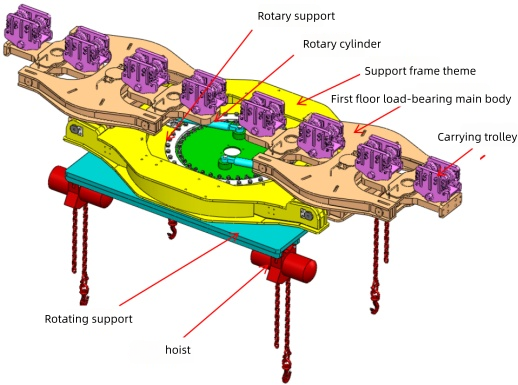
This assembly consists of the following core components:
- Load-bearing trolley — travels along the monorail rail, distributing the lifted load across the track
- Primary load-bearing structure (first layer) — the main structural frame that carries the full rated lifting capacity
- Support frame body — the intermediate structural assembly connecting the load-bearing structure to the rotating mechanism
- Hydraulic rotation cylinder — actuates the rotation of the swing frame through controlled oil cylinder extension and retraction
- Cover plate — protective housing for the rotating mechanism assembly
- Rotating support frame — fixed to the inner ring of the rotary bearing; rotates with the inner ring as the cylinder actuates
- Four lifting hoists — evenly distributed across the rotating frame, providing balanced four-point lifting for large-format loads such as hydraulic roof supports
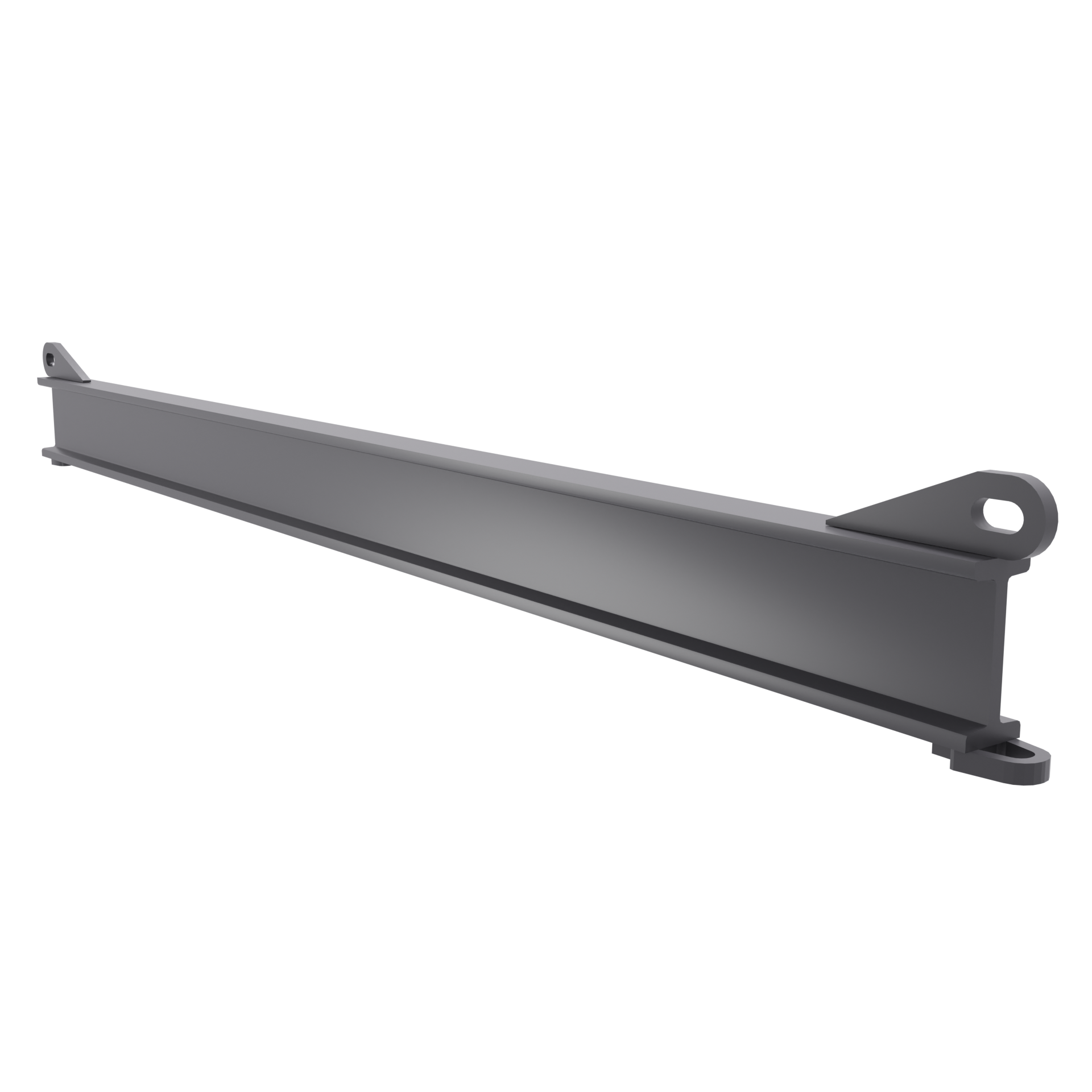
The two ends of the rotating lifting beam connect to the monorail transport locomotive via tie rods, allowing the locomotive’s hydraulic system to power both travel along the monorail and actuation of the rotating lifting beam’s hydraulic cylinder.
How the Rotating Lifting Beam Works
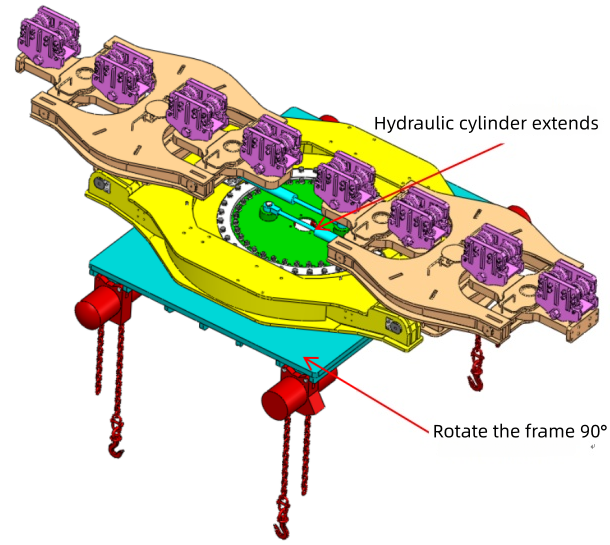
This system operates through a hydraulic rotary bearing mechanism. The hydraulic cylinder’s extension and retraction drives the inner ring of the rotary bearing, which rotates the swing frame mounted on it. This mechanism enables a full 0–90° rotation range, allowing the load to be repositioned from its original orientation to a perpendicular position in a single operation.
Step-by-Step Operating Sequence
- Integration — The rotating lifting beam is connected into the monorail transport locomotive system via tie rods at both ends. The locomotive’s hydraulic power supply drives both travel and beam actuation.
- Travel to position — The monorail transport locomotive moves the beam along the monorail track to the designated underground work location.
- Four-point lift — The four hoists distributed across the rotating frame are lowered and attached to the load (typically a hydraulic roof support). The hoists lift the equipment clear of the floor simultaneously.
- Hydraulic rotation — The operator controls the hydraulic cylinder to rotate the swing frame and the suspended load to the required angle and direction — up to 90° from the original position.
- Placement — Once correctly oriented, the load is lowered into its new position. The unit is then reset and the locomotive repositions for the next lift.
Key Advantage: Compact Length vs. Conventional Lifting Beams
A major engineering advantage of this design is its significantly shorter overall length compared to conventional fixed lifting beams of equivalent capacity. A standard 48-tonne fixed lifting beam typically measures approximately 14 metres in length. This compact rotating lifting beam achieves the same 48-tonne rated capacity at just 4.5 metres total — less than one-third the length.
This compact length delivers two critical operational benefits in underground coal mine environments:
- Navigates tighter turning radii — minimum horizontal turning radius of 6 m and vertical turning radius of 12 m, allowing deployment in roadways where a 14-metre beam would be unable to manoeuvre
- More concentrated load transfer to rail — because the load is concentrated over a shorter span, rail specification requirements are higher; a 1.2-metre heavy rail section is required when operating at full 48-tonne capacity
Technical Specifications
| Parameter | Unit | Value |
|---|---|---|
| Max Overall Dimensions (L × W × H) | m | 4.5 × 1.85 × 0.7 |
| Min Horizontal Turning Radius | m | 6 |
| Min Vertical Turning Radius | m | 12 |
| Max Lifting Capacity | t | 48 |
| Rotation Range | ° | 0–90 |
| Number of Lifting Hoists | — | 4 (evenly distributed) |
| Beam Weight | t | 6.6 |
| Min Rail Requirement (at full load) | — | 1.2 m heavy rail section |
| Connection to Locomotive | — | Tie rods, both ends |
| Actuation | — | Hydraulic cylinder (locomotive supply) |
Primary Application: Hydraulic Roof Support Relocation
The rotating lifting beam is most commonly deployed in longwall coal mine operations for the relocation and reorientation of hydraulic roof supports during face moves and roadway development. Hydraulic roof supports are among the heaviest and most difficult items to manoeuvre underground — typical weights range from 20 to 48 tonnes, and their orientation must be precisely controlled during repositioning to match the new face alignment.
By integrating this system into the monorail transport locomotive, mine operators can lift, rotate, and precisely place hydraulic roof supports in a single continuous operation — eliminating the need for additional ground-based equipment, reducing repositioning cycle time, and significantly lowering the number of personnel required in the immediate work area during the lift.
Frequently Asked Questions
What is the maximum lifting capacity of the rotating lifting beam?
The maximum rated lifting capacity is 48 tonnes, making it suitable for the full range of hydraulic roof support sizes used in longwall coal mining operations. At full 48-tonne capacity, a 1.2-metre heavy rail section is required to meet the concentrated load requirements of the shorter beam configuration.
How does the rotating lifting beam differ from a standard fixed lifting beam?
A standard fixed lifting beam can only raise and lower loads vertically. This attachment adds a hydraulically controlled 0–90° horizontal rotation axis, enabling load reorientation without repositioning the locomotive. Additionally, at just 4.5 metres long compared to the 14-metre length typical of fixed 48-tonne beams, it is significantly more manoeuvrable in tight underground roadways.
What monorail rail specification is required for this lifting beam?
Due to the concentrated load distribution of the compact beam design, a 1.2-metre heavy rail section is required when operating at maximum 48-tonne rated capacity. Standard I140 rail sections used for personnel and lighter material transport may not be sufficient — rail specification must be confirmed with Relystone engineers at the project planning stage.
Can the rotating lifting beam be integrated with any monorail transport locomotive?
This component is designed for integration with Relystone monorail transport locomotive systems and connects via tie rods at both ends. The locomotive’s hydraulic power supply drives both travel along the monorail and actuation of the rotating cylinder. Compatibility with specific locomotive models and hydraulic system capacity should be confirmed with Relystone’s engineering team based on your mine’s operating requirements.
What is the rotation range of the rotating lifting beam?
The beam provides a 0–90° rotation range, controlled by the hydraulic cylinder’s extension and retraction. This range is sufficient for the majority of hydraulic roof support relocation and reorientation operations encountered during longwall face moves and roadway development in underground coal mines.
Get a Custom Rotating Lifting Beam Configuration
Relystone designs and manufactures rotating lifting beam systems for underground coal mines, metal mines, and tunnel construction projects across 30+ countries. Every configuration is engineered to your mine’s specific roadway dimensions, turning radius requirements, lift capacity, and monorail locomotive system specifications.
Contact Relystone for a technical consultation and project-specific quote →
ビジョンとミッション
私たちは、絶え間ない技術革新と卓越した製品品質を通じて、世界中のお客様に安全で効率的、かつ環境に優しいソリューションを提供し、業界の進歩を促進し、より良い未来を共に創造していくことをお約束します。.
コア・バリュー
私たちは顧客のニーズに導かれ、そのシナリオを深く理解し、期待を上回る製品とサービス体験を提供し、永続的なパートナーシップを確立・維持します。.人としてのあり方 | 物事の進め方 | ビジネスの進め方 | 実践的イノベーション | 卓越性を追求する | チームスピリット
その他の製品
瑞石智能科技(山東)有限公司.
瑞石智能科技(山東)有限公司は2022年10月に5000万元の資本で設立され、鉱山機械の生産と販売を統合している。Menciusの故郷であるZouChengに位置し、敷地面積は11,000m²、50名以上の専門家を擁し、強力な研究開発と製造サポートを保証しています。長年の実践により、鉱業、金鉱、電力部門に対応する完全な流体制御ポートフォリオを生み出し、そのユニークで高品質、信頼性の高い設計は、顧客の高い評価を得ている。精鋭のアフターセールス・チームに支えられ、リーストーンは ’集中、革新、実用、効率 “の精神と、”品質は生存のために、技術は発展のために、管理は効率のために、ブランドは市場のために “という原則に従っています。高性能の製品、専門家のサポート、緊密な協力は、相互利益とウィンウィンの結果をもたらします。.